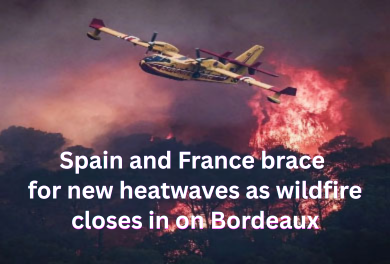
Spain and France brace for new heatwaves as wildfire closes in on Bordeaux
Wildfires are tearing through France and Spain, forcing more than 300,000 people to evacuate their homes.
France has seen its worst fires in two decades, while officials in the Spanish capital Madrid say they are the worst the region has ever experienced.
It follows a sweltering summer of heatwaves across Europe that have seen temperatures soar above 40C (104F) in many places.
Separate wildfires in the regions outside Madrid have together burned about 297 sq miles (770 sq km), authorities estimate – an area larger than the city itself.
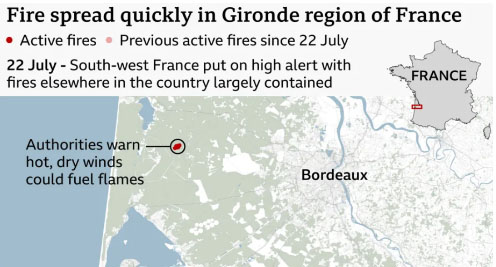
France’s south-west regions Gironde and Landes are under “yellow alert” for a heatwave expected to peak on Wednesday 29th Jul 2026, further hampering efforts to contain “very unpredictable” blazes in Gironde.
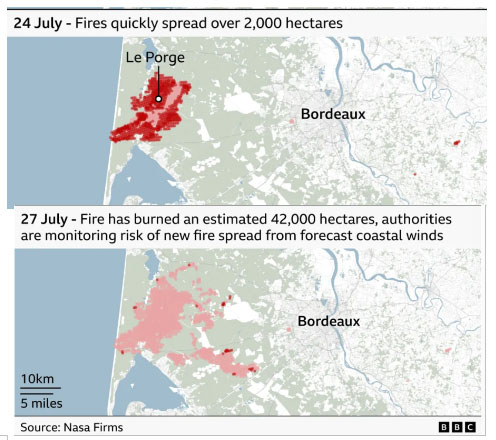
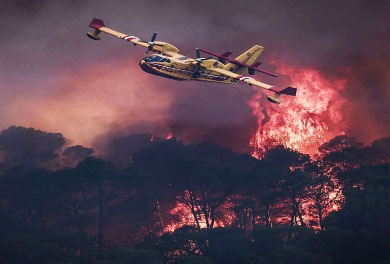 As one of the wildfires burning in France is 15km from the south-western city, “We are preparing to accommodate a large number of people should further evacuations be ordered,” said Thomas Cazenave, the mayor of Bordeaux.
Some 220,000 people have been evacuated in France and more than 100,000 in Spain, where fires are burning “uncontrolled” west of Madrid.
President Emmanuel Macron, said that the country was facing a “completely unprecedented wildfire” – the “toughest since World War Two”.
French Prime Minister Sébastien Lecornu warned the country “is going through an unprecedented fire season”, with 116,085 hectares (286,852 acres) burned and 13,566 fire starts recorded since January
Jerome Steffe, the mayor of Cestas, a town south of Bordeaux, told the BBC this “will be the fire of the century”. So far, he said, the region has seen 42,000 hectares (103,000 acres) of land burned and 240 houses destroyed. Although the fire is no longer moving as quickly, he said his teams have “won only a small battle” and emphasized that the risk remains from flying embers or a sudden change in wind direction.” We put all our energy into creating protective firebreaks,” he explained, but admitted “we are all scared in front of this situation.”
The minister revealed in a post on X that nine out of 10 fires “are human-caused and most arise from carelessness: a cigarette butt, a barbecue, work carried out without precaution.
But he also said that not all these fires are accidents and some are deliberately set, adding that since 6 July, 162 arrests have taken place.
Wildfires are also burning in several other French regions, including Var and Landes, and also in Haute-Corse on the island of Corsica.
Meanwhile, neighbouring Spain on Monday entered its fifth day of a national emergency because of raging wildfires west of the capital Madrid.
BBC Verify has been analysing satellite imagery showing the spread of the wildfire west of Madrid, which has now affected more than 27,000 hectares.
The images show the rapid expansion of the burn scar as the wildfire spread.
References:
https://www.bbc.com/news/articles/cj638jx0l53o
https://www.bbc.com/news/articles/ckg34128nvpo
Spain and France are bracing for new heatwaves with temperatures soaring past 40°C in some regions.The long-term normal average temperatures in June typically range
The long-term average temperatures in Paris is 22 deg C. In July 2026 the intense heatwaves triggering red heat alerts with peaks scaling up to 41°C.
While climate factors like extreme heatwaves and severe droughts dry out the vegetation and make the landscape highly flammable, nature itself rarely provides the actual ignition spark. A wildfire cannot start from high weather temperatures alone. Even during the most severe heatwaves where ambient air temperatures reach 45°C to 50°C, the environment never gets hot enough to trigger spontaneous combustion in nature
It requires an external ignition source because dry wood and leaves require a flashpoint temperature of roughly 300°C (572°F) to naturally burst into flames.
“Natural” Forest Fires may Start due to :
Lightning Strikes: This is the most common natural cause. A single lightning bolt heats the surrounding air to around 30,000°C, instantly vaporising moisture and igniting trees or ground litter.
Volcanic Activity: Hot lava, ash, or volcanic sparks easily exceed 500°C to 1,000°C, instantly igniting nearby vegetation.
Spontaneous Combustion (Rare): Very rarely, deep and tightly packed piles of decomposing organic matter can generate internal bacterial heat that slowly cooks the material into pyrophoric carbon, occasionally self-igniting at lower sustained temperatures. However, this almost never happens to loose leaves or standing trees on a normal forest
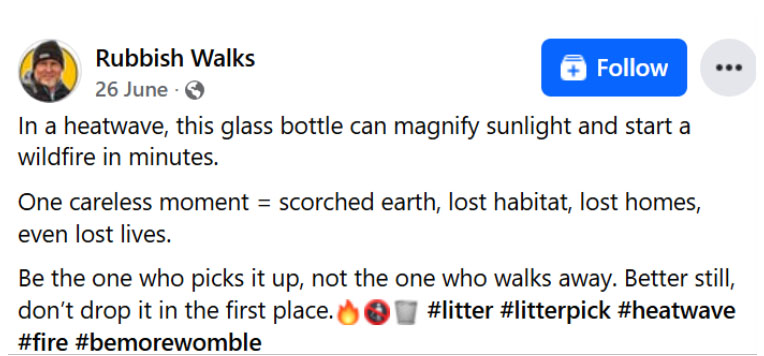
Another reason other than above is as mentioned below:
https://www.facebook.com/UKrubbishwalks/videos/in-a-heatwave-this-glass-bottle-can-magnify-sunlight-and-start-a-wildfire-in-min/1013306677841748/
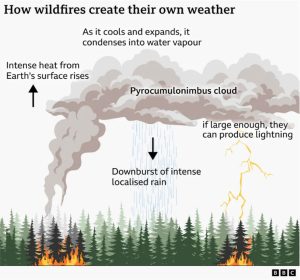
Wildfires can create their own weather:
The fires have become so extreme they have created their own giant fire thunderstorm.
A rare weather event, storms like these are formed when heat from the wildfires makes the air above the fire rise rapidly, carrying smoke, ash and water vapour high into the atmosphere.
As the air rises, it cools, and the water vapour condenses into a cloud. If the fire is powerful enough and the atmosphere is unstable, that cloud can grow into a cumulonimbus – the same type of cloud associated with thunderstorms.
If these clouds then become large enough, they can produce their own lightning, which can then start new fires. They can also occasionally bring hail and rain.
These extreme and unpredictable conditions make the fires all the more difficult to stop.